Koose Munisamy Veerappan, or ‘Santhana Kadathal Veerappan’ as he was called colloquially in Tamil Nadu, was and continues to be an enigma in Tamil socio-political imagination. When Veerappan and his gang killed police officers, killed elephants for their tusks, smuggled sandalwood, and, of course, infamously kidnapped Kannada superstar and film icon Raj Kumar, the public perception about Veerappan was quite straightforward; he was a criminal and his criminal enterprise inside the forests needed to end.
But, today, public perception surrounding Veerappan has changed, casting a positive light on his legacy. He has become an icon for a section of Vanniyar youth for his valour; he has been called, ironically, as a ‘protector of forests’ (despite cutting down sandalwood trees and killing thousands of elephants) by a section of Tamil nationalists. And crucially, his entire organised criminal activity has been, over time, recast as a mere reaction to the ‘injustices’ meted out by the police against the people. Now, the latest six-part ZEE5 series, Koose Munusamy Veerappan, tells the story of Veerappan, his conflict with the police and the people who were caught between them; it’s been directed by Sharath Jothi and created by Jeyachandra Hashmi, Prabbhavathi and Vasanth Balakrishnan.
The docu-series is indeed an attempt to present the story of Veerapan through his video interviews given to the popular Tamil magazine Nakheeran over the years in the 90s, in which he explains his own crimes in a child-like, candid manner. For instance, he details how he ambushed and killed police battalions, often justifying it by pointing to police atrocities. However, the real story of Veerappan and his hunt, as obvious as it is today, is about the people who were sandwiched between the impatient egotistic police force acting with increasing impunity against commoners to nab Veerappan and avenge the death of their comrades, and the mercurial Veerappan himself, who didn’t tolerate anyone going against him.
The first season tries to shine a light on why Veerappan chose to continue his life of crime, his justifications on why he murdered so many top cops, and why he didn’t think of surrender as an option despite being witness to the suffering of common people at the hands of police. There are also detailed descriptions and enactments on several ambushes that Veerappan was involved in that showed that he was a good guerilla warfare strategist.
Three well-known incidents define the hunt for Veerappan and his gangs through the 90s: the killing of Divisional Forest Officer and head of Special Task Force, P. Srinivasan; the ambush of a police party, including that of Superintendent of Police in the Special Task Force ‘Rambo’ Gopalakrishnan, killing 22 cops and leaving others including Gopalakrishnan IPS wounded for life; and the alleged organised torture and rape of locals by the police inside what was harmlessly called ‘workshops’ in the hope of dissuading them from helping Veerappan and getting information about his whereabouts.
Koose Munisamy Veerappan (Tamil)
Creators: Jeyachandra Hashmi, Prabbhavathi RV, Vasanth Balakrishnan
Director: Sharath Jothi
Episodes: 6
Runtime: 40 to 50 minutes
Storyline: The story of the infamous forest brigand told through testimonials from journalists, politicians, police, victims’ families and the bandit himself through a series of interviews he gave in the 90s
Many might remember another series that came out on Netflix recently, The Hunt For Veerappan, which pretty much discussed most of the major incidents until he was shot dead in 2004. The idea that STF head Srinivasan was a Gandhian and was well-loved by the people is reinforced here, but Veerappan and sometimes, ‘Nakkeeran’ Gopal — the journalist who interviewed Veerappan in the jungles — cast considerable doubt over his character.
Secondly, SP Gopalakrishnan’s alleged inhuman treatment and exploitation of people in the villages to get information about Veerappan and provoke him to come out to fight him is discussed in detail. However, SP Gopalakrishnan succumbs to his own bravado when vans carrying policemen exploded after they passed over landmines placed by Veerappan and his gang. This became a turning point in the hunt for Veerappan, explained by retired Director General Of Police A.X. Alexander, as the killing of 22 persons including police men, forest officials and informers, reinvigorated the police force. It is the alleged police atrocities of the people suspected to have links to forest brigand and his gang in the so-called ‘Workshop’ that illuminates the pointlessness of the legacy that Veerappan has gained today among a section of the youth, who celebrate him as a Tamil icon.
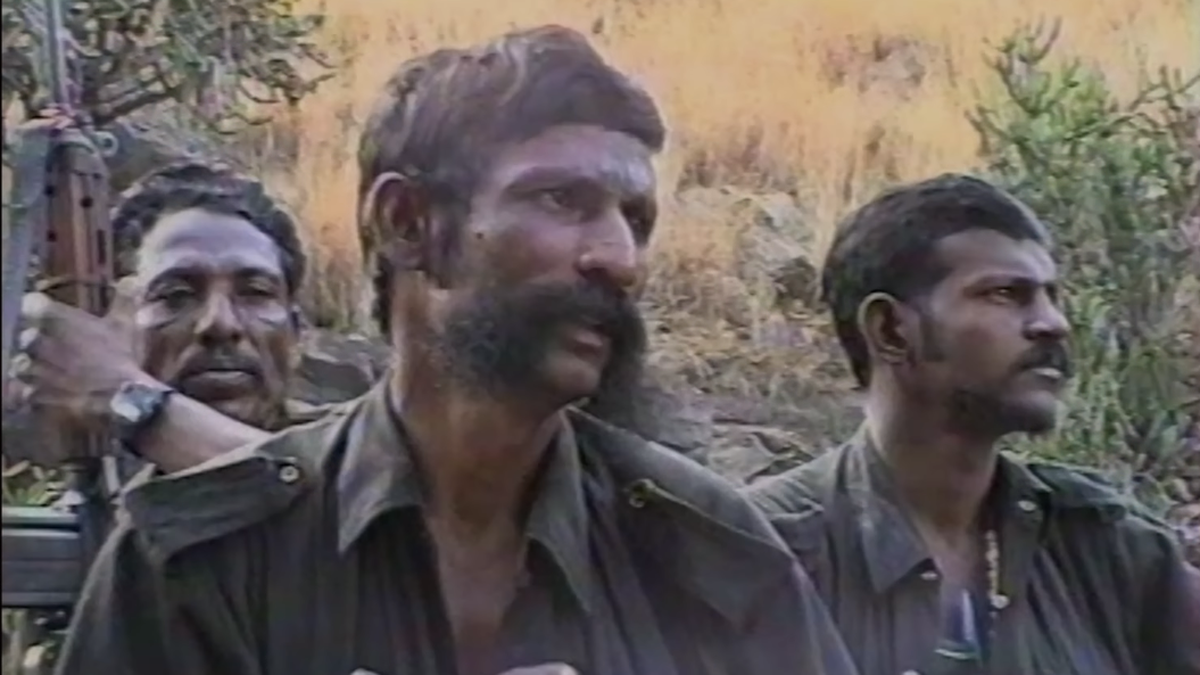
A still from ‘Koose Munisamy Veerappan
| Photo Credit:
ZEE5
While police atrocities should be condemned without any reservations, it is hard to miss Veerappan’s defiance in not surrendering to the police even while expressing his righteous indignation against police atrocities, when he could have ended the suffering of the people by simply surrendering to the police for his crimes. He does express his concern that he might be killed by the police if he surrenders just like his comrades, but it doesn’t justify why he continues to attack and kill policemen.
The web series also highlights the political preferences of Veerappan in Tamil Nadu; he holds a soft corner for M.G. Ramachandran, advises actor Rajinikanth to start a new party and not be a stepping stone for someone else, gives a resounding vote of confidence for former DMK president and Chief Minister M. Karunanidhi, MDMK chief Vaiko, Communists, minority parties, and PMK founder Dr S. Ramadoss, while also expressing his wish to participate in electoral politics. He reserves his criticism for former Chief Minister and AIADMK general secretary J. Jayalalithaa, under whose regime in 2004, he was eventually killed.
While there are some ‘rebels’ around the world who genuinely chose a life of an armed guerilla in conflict with the State as a way of liberating their people, the show makes it clear that Veerappan chose a life of crime to make a living and began delivering political sermons and overt moves, including helping the Tamils who were attacked in Karnataka during the Cauvery river water sharing crisis, only as an afterthought. Colombian drug lord Pablo Escobar, who earned the moniker ‘King of Cocaine’, also harboured lofty political ambitions and was seen as a saviour in Medellin’s poorest neighbourhoods.
It is not easy for anyone, let alone Veerappan, who knew his way around the jungles, to organise a rag-tag gang of men and take on the police force of two State governments, sell and buy illegal goods and remain elusive for 14 years without the help of powerful people in the system. Who are they? That remains a mystery. Having said all this, it will be curious to see how the makers are going to present the real suspense of how Veerappan was actually lured out of the forest and killed. The final part of the Veerappan story has been the most contentious, and it remains to be seen if the makers can remove the veil and tell the truth.
Koose Munisamy Veerappan is currently streaming on ZEE5